
The Owner Relationship Starts and Ends With the Numbers
When an ownership group selects a hotel management company, they are making a trust decision. They are handing over a capital asset and expecting, in return, operational competence and financial transparency. The contract formalizes the arrangement but the reporting sustains, or erodes, it.
Most ownership groups are not asking for anything unreasonable. They want to know how their asset is performing. They want the numbers delivered on a predictable schedule, be able to ask a follow-up question and get an answer that traces back to the same data, and when performance is off, they want to understand why before they have to ask.
What they frequently get instead is a monthly package that arrives two weeks after period-end, assembled from multiple sources, occasionally inconsistent with prior reports, and formatted differently enough from the previous management company’s package that direct comparison is impossible. The numbers may be accurate, but the presentation creates doubt, and doubt in the owner relationship is expensive.
This is not primarily a technology problem. It is a workflow and data infrastructure problem and it is one that the right hotel finance platform can largely solve.
What Owners and Asset Managers Are Actually Looking At
Understanding the reporting gap requires starting from the owner’s perspective, not the controller’s.
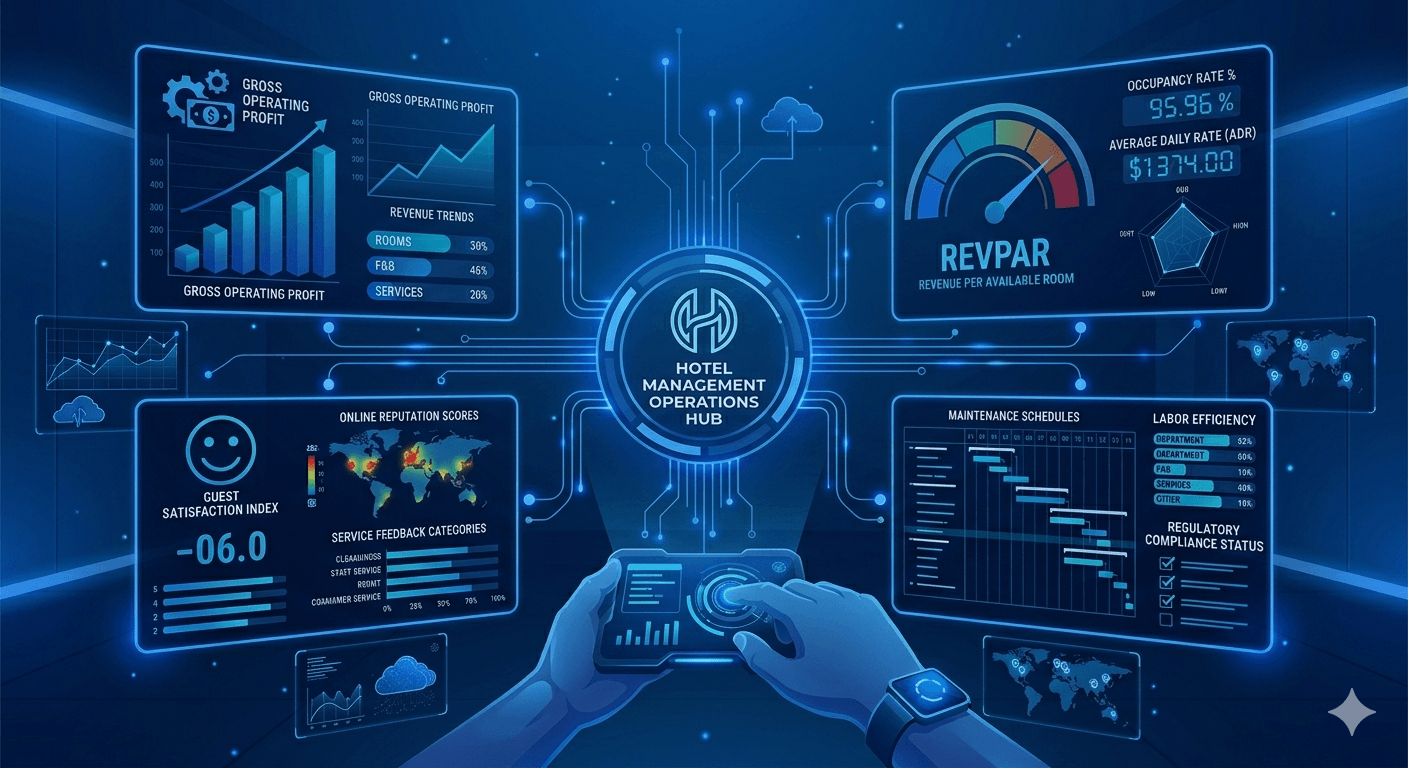
A sophisticated ownership group or asset manager is typically tracking a handful of metrics with real intensity: NOI against underwriting assumptions, GOP margin relative to comp set and prior year, RevPAR index, and labor cost as a percentage of departmental revenue. Everything else is context. The monthly package that matters most to them is the one that answers quickly and clearly whether this asset is on track, and if not, where the deviation is occurring.
Asset managers in particular are looking for comparability. They hold positions across multiple management companies and brands. When they review their portfolio, they need to be able to read a P&L from a management company using Data Plus in Pittsburgh the same way they read one from a different operator in Phoenix. Inconsistent department structures, non-standard USALI mapping, and idiosyncratic statistics reporting force asset managers to mentally reformat every report before they can analyze it. That friction accumulates, and eventually it becomes a conversation about whether the management relationship is working.
Ownership groups with institutional investors or lenders behind them face an additional layer of expectation. Lenders and equity partners expect reporting that is structured, timely, and audit-ready. A management company that cannot deliver that consistently is creating covenant risk for the ownership group and they remember that.
When a number looks unexpected, they want the ability to see the underlying detail without submitting a request and waiting three days for a response. The management companies that deliver this earn longer relationships and smoother conversations. The ones that cannot are perpetually on the defensive.
Why Most Management Companies Struggle to Meet These Expectations
The gap between what owners expect and what management companies deliver is almost always structural.
Most hotel management companies are managing portfolios that were assembled over time, not built to a single standard. Each property came with its own PMS, its own historical chart of accounts structure, and its own accounting staff with their own habits. Standardizing all of that after the fact is genuinely difficult work, and many management companies have never fully completed it.
The result is a corporate finance team that spends the back half of every month doing reconciliation work that should be automated: PMS exports get reformatted, labor reports from three different payroll providers get consolidated into a common template, and department codes that map slightly differently at two properties get manually adjusted so the portfolio roll-up is consistent. By the time the owner pack is assembled, it reflects financial reality as it existed 10 to 14 days ago.
In that environment, the management company’s finance team is not doing analysis. They are doing production. And the owner is receiving a document that tells them what happened, not what is happening.
The management companies that consistently outperform on owner satisfaction are typically the ones that have solved the infrastructure problem: a standardized chart of accounts applied across every property, automated data flows from PMS and payroll into a single general ledger, and a reporting layer that produces owner-facing outputs directly from live financial data rather than from a manually assembled spreadsheet.
How Data Plus Enables Management Companies to Deliver Investor-Grade Reporting
Data Plus was built specifically for the hospitality industry, and its architecture reflects the reality of how hotel portfolios actually operate: multiple properties, multiple systems, and a corporate finance team that needs a consolidated view without a two-week assembly process.
DP Finance is the core platform. It functions as a single general ledger environment across the entire portfolio, with full 12th Edition USALI compliance built in, not bolted on. Every property in the portfolio maps to the same standardized chart of accounts. Departmental P&Ls, statistics, and KPIs are calculated consistently across every asset. When an owner asks for a side-by-side comparison of GOP margin across five properties, the corporate finance team runs a report. They do not spend a day reformatting five separate trial balances.
The automated import capability is where DP Finance changes the daily workflow most materially. Rather than waiting for property accounting staff to export and upload revenue data, DP Finance pulls nightly journal entries directly from PMS, POS, time and attendance, and payroll systems through hundreds of native integrations. The general ledger reflects current financial reality, not last week’s manual upload. That means when an asset manager logs in to check how a property is tracking against budget midmonth, the data is there.
DP Connect handles the integration edge cases that every portfolio has: the recently acquired property running a niche PMS, the ownership group that wants to pipe financial data into a proprietary BI environment, the management company building a custom connection to a specialized reporting tool. Rather than treating non-standard systems as permanent manual exceptions, DP Connect routes every property into the same consolidated ledger regardless of what operational system sits behind it.
DP Invoice ensures that the accounts payable detail feeding the general ledger is clean and consistently coded. AI-powered capture with 99.5% accuracy eliminates the manual data entry errors that quietly distort department-level P&Ls, which are exactly what generates the follow-up questions from ownership that nobody wants to answer. Automated approval workflows mean invoices move through the platform on a defined schedule, not according to whoever remembered to check their email.
DP Pay completes the payables cycle with automated payment processing fully reconciled back to the GL in real time. The cash flow picture ownership sees reflects what is actually happening. Fraud controls and audit trails are embedded, which matters when management companies are managing assets on behalf of institutional owners with governance requirements.
Together, these modules replace the manual assembly process with a live, integrated data environment. The owner pack is not produced from spreadsheets, but is generated from a general ledger that is current, consistently structured, and fully traceable.
What the Owner Pack Should Look Like in a Modern Finance Stack
The deliverable that matters most to ownership is the recurring owner pack that lands in their inbox at a defined time each month and gives them a clear, complete view of asset performance.
In a management company running on Data Plus, that pack is built directly from DP Finance. There is no parallel data assembly. The numbers in the owner pack are the numbers in the GL. Variances are explainable because the underlying detail is one drill-down away.
A well-structured owner pack produced on this infrastructure typically includes a portfolio-level roll-up of NOI, GOP, and RevPAR against budget and prior year; property-level P&Ls in USALI format with statistics; a clear variance narrative for material deviations; and a forward-looking comment on the months ahead. Critically, it is delivered on a predictable schedule (within two to three business days of period-end), not whenever the last property submits its data.
That schedule reliability is itself a trust signal. An owner who receives their pack on the 5th of every month, consistently, without having to follow up, has a different relationship with their management company than one who sends a reminder email every month and still waits. The reporting cadence communicates operational competence before the owner reads a single number.
The Management Company Differentiation Nobody Talks About
There is a significant body of conversation in hotel management about revenue management sophistication, brand relationships, F&B programming, and cost controls. There is comparatively little conversation about financial reporting infrastructure as a competitive differentiator, which is precisely why it is one.
Ownership groups and asset managers talk to each other. When a management company consistently delivers clean, timely, USALI-compliant reporting that holds up to scrutiny and responds to follow-up questions with data rather than explanations, that reputation travels. When a management company’s reporting creates regular confusion or requires ownership to do their own reconciliation work, that reputation travels too.
For CFOs, finance directors, and corporate controllers at hotel management companies, the business case for investing in the right financial infrastructure is not just operational efficiency, though the close-cycle gains alone typically justify the cost. It is the owner relationship, and everything that flows from it: contract renewals, new property assignments, and the ability to attract institutional ownership groups that have options about who manages their assets.
Data Plus provides the infrastructure to make that differentiation real. A standardized, USALI-compliant general ledger across every property. Automated data flows that eliminate manual assembly. An AP and payments cycle that keeps financial data current and controlled. And the reporting layer to deliver owner packs that reflect what is actually happening in the portfolio, not what happened two weeks ago.
For management companies ready to make owner reporting a strategic asset rather than a monthly fire drill, the conversation starts at dphs.com.


